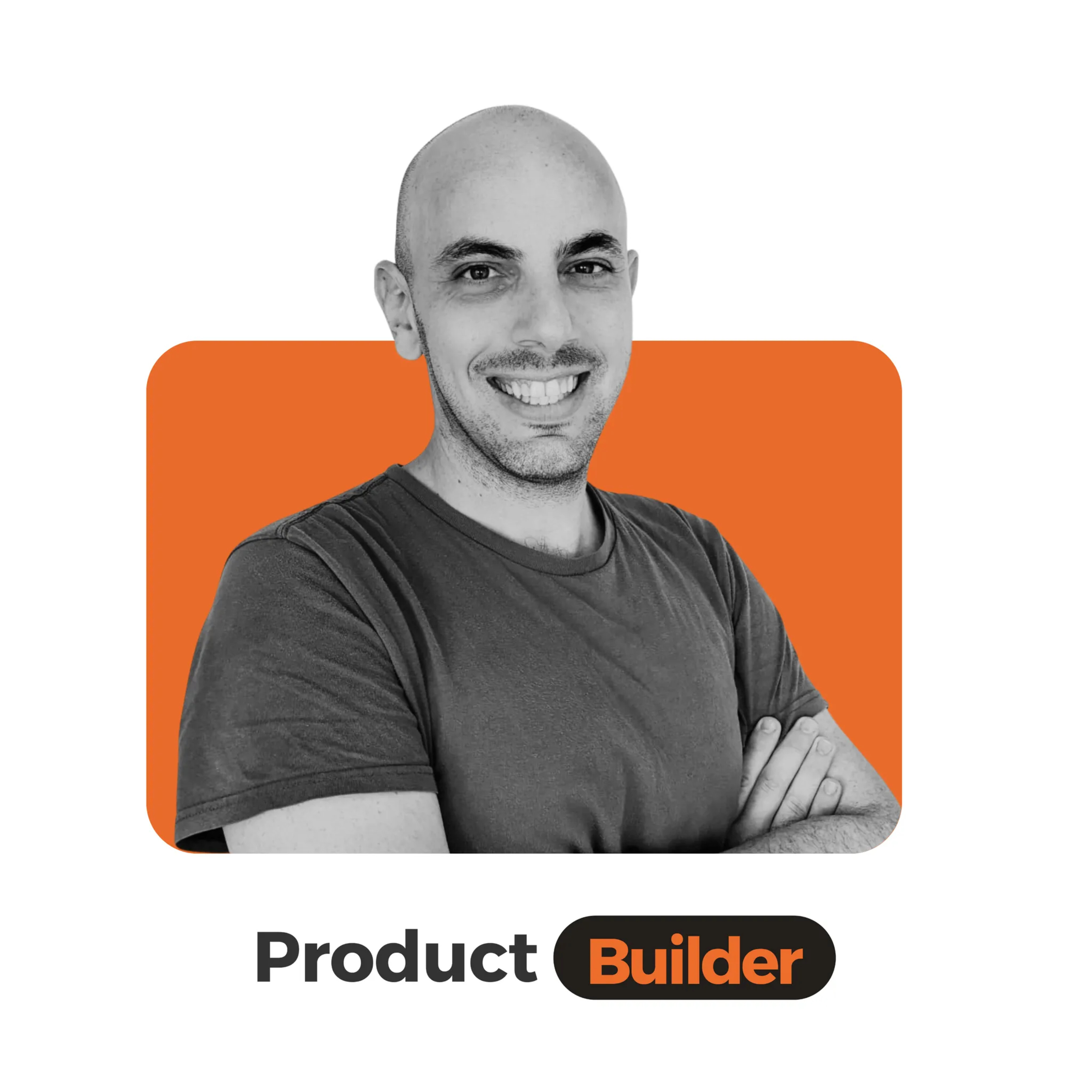
Building a Company, Not Just a Product: Early-Stage Product Management at Cinch
Host: Eyal David · Guest: Shuki Aharonovich · About the host
In this episode
- At early stage you come to build a company, not just a product — the product mindset needs to permeate sales, customer success, onboarding and every process in the company, otherwise you create debt you'll pay for later.
- Small teams demand an intensity and closeness you don't know at mid-size: zero organizational buffer, critical soft skills, and this is the team you win with — not one you replace.
- The central role at early stage is to make sure you're on the way to product-market fit — asking every morning whether you got closer or further away, even when the signals are soft and from the gut.
- Before you look for a role, do discovery on yourself: get out of your head and your comfort zone, talk with PMs and strangers, and form a clear criterion for what you want.
- In the high-touch enterprise world there's little data — decisions rely on relationships, trust and gut feeling; the UX wins are the fast ones, but the business value (savings, reconciliation) arrives on a cycle of months.
- The deal-breaker for a first product is the relationship with the CEO/co-founder who holds the product — you need mutual space, trust and commitment you can rely on.
Listen to this episode
Episode Description
Shuki Aharonovich returns for a second episode, this time as the first product manager at Cinch — an early-stage startup in the world of logistics and supply chain for manufacturing companies. After a tenure at Augury he was looking for a real adventure, the 'Harry Potter' of a small team, and joined a two-room company. The conversation distills three insights about what sets apart product management at early stage: building a company and not just a product, embracing the intense dynamic of small teams, and keeping a hand on the pulse of product-market fit. Alongside that — work-life balance, stress, and working from the gut in a high-touch enterprise world with almost no data.

Full transcript with speakers and timestamps
Selected quotes
“Instead of building a product at the level of a product, build at the level of a company — and the company is the product.”
“And what I wanted was Harry Potter — I wanted to be part of a small team going on a journey like that, good versus evil, doing the impossible.”
“It hurts me very, very much that people just give up on the opportunity to be happy at their work.”
Questions & answers
What does Cinch do?
Cinch is a logistics product for manufacturing companies that need to receive raw materials and ship finished products in complex global shipments. The product helps with the sourcing and bidding process (choosing a supplier and a route), and performs reconciliation between invoices and price quotes to spot discrepancies and save money — instead of the existing mess of emails, PDFs and Excels in binders.
What are the three things that set apart product management at early stage?
First, you're here to build a company and not just a product — to apply a product mindset to all the company's processes. Second, to understand and embrace the intense dynamic of small teams. Third, to be responsible for making sure you're on the way to product-market fit, with a hand on the pulse.
What's the metric that guides Shuki every morning?
At this stage there isn't one sharp metric — a lot of it is from the gut. He looks for deals to sell faster and for customers to expand (to more sites and regions), and asks after every customer call whether the customer loves/wants us and whether we're at risk — red or green. Bottom line: did we get closer to or further from product-market fit?
What's his advice for someone starting or mid-career in product?
To juniors: the episode is less relevant to you — take any role, do your best and grow from there, and invest in a lot of reading and reflection. To mid-career: ask yourself what you're really looking for and why, build the search like a product (job to be done, outcome), and do real discovery — talk with people and don't stay inside your own head.
How does work-life balance change at a small startup?
For the better: the overhead plummets, decisions are made in a room within ten minutes, there are no endless internal meetings — the absolute number of hours is reasonable and you have control over your schedule. For the worse: the stress level is higher, with constant general worry and a tense level of alertness, because almost every point is make or break.
Related Episodes
No More Moats: How Harmony Reached 50 Customers Without a Single Salesperson | Ran Ribenzaft (Harmony)
01:00:56 · September 24, 2026
Ran Ribenzaft, Co-Founder and CTO of Harmony (and formerly founder and CTO of Epsagon, sold to Cisco for $500M), is an unusual CTO: 90% of his time go...
Peter Paltchik: Wants to Be Israel's Most Influential Athlete
00:54:27 · September 6, 2026
Peter Paltchik — two-time Olympic judo medalist, entrepreneur, speaker and investor — on what really sustains people who build over the long haul: the...
Tony Arad Felik | Not Just Surviving AI — How to Thrive in It
01:06:04 · July 28, 2026
Tony Arad Felik, a mentor to managers in high-tech and a former R&D Director, on management in an era when roles, hierarchies and expectations are shi...

Aviad Harel | Team8 | How to Build a Thesis About the Future Worth Millions
00:54:32 · June 22, 2026
Aviad Harel, Managing Partner at Team8 and previously a co-founder of Sisense, on how to build startup theses at the earliest stages — before product,...