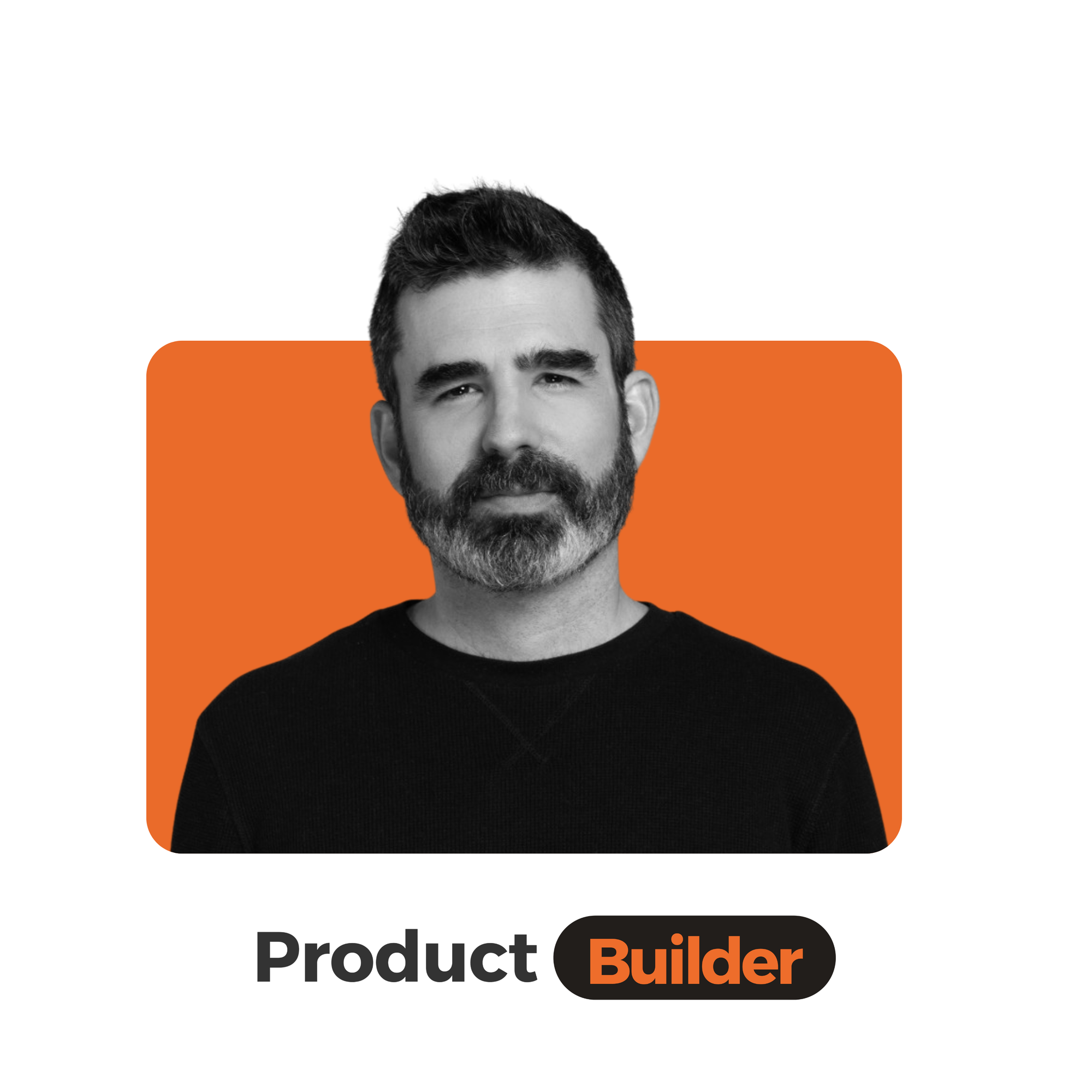
Storytelling in Product: Shay Shprank (Empathy) on Making the Product Tell the Story
Host: Eyal David · Guest: Shai Shafrank · About the host
According to Shay Shprank, VP Product at Empathy, a good product tells the story itself — like a hammer that needs no explanation. Much of early-stage product work is distilling a complex world into one simple story the product embodies, like Work/Life/Balance at Lili or Empathy as loss broadly, to rally users and the organization around that idea.
In this episode
- A good product tells the story itself — like a hammer that needs no explanation. At the early stage, a large part of product work is distilling a complex world into a simplicity the user grasps at a single glance (Work/Life/Balance at Lili, Empathy as loss in the broad sense).
- The first MVP comes to tell a story before it solves a specific problem: Empathy chose a broad, end-to-end product in order 'to own the market,' rather than a point solution for closing accounts — because they had the runway for an extended process.
- User interviews are the gold: Shay recruited interviewees through Respondent.io within two days, and the key realization was that everyone has 'a different movie' — which justified a broad product rather than a single solution.
- Product-market fit is not a one-time station before growth — good companies keep doing zero-to-one. Fiverr's big step functions (Beyond Five Dollars, service-as-a-product) were PMF, not optimization.
- To rally an organization behind an idea you need 'internal sales': Shay invested hours in presentations and pulling data to convince leadership, and learned there what it means to be an enabler and to give the right reasoning.
- A resume for a product role is itself a product — with a function, success metrics and a user experience. Invest in usability and readability, not in over-design and progress bars.
Listen to this episode
Episode Description
Shay Shprank, VP Product at Empathy, joins Eyal on Product Builder for a conversation about storytelling in product — how you distill a complex world of problems into a simple story that the product itself tells. Shay walks through his path from studying industrial design at Bezalel, through the startup WeBetter, Fiverr and Lili, to building Empathy's first product — a company that helps American families cope with loss. The episode is full of practical examples on MVP, ongoing product-market fit, and rallying an organization behind an idea.

Full transcript with speakers and timestamps
Selected quotes
“It's product, in the end it's storytelling.”
“You look at the product, you understand the story. You look at a hammer, no one needs to explain it to you.”
“A resume is a product — it has a function it needs to fulfill, it has success metrics, it has a user experience.”
Questions & answers
What does Empathy do?
A company that helps American families cope with the loss of their loved ones — both emotional support (emotional support, grief support) and the practical coping: the checklist of what needs to be done, closing accounts, paperwork, and automations that let you do it in an organized, collaborative way.
How did Shay solve the need to interview families who had lost loved ones?
He found a research platform called Respondent.io that lets you recruit people for interviews by criteria — including people who lost a family member in the past year. Within two days he started talking with about three people a day.
What was the central product principle that recurs with Shay?
That the product should tell the story itself. Lili distilled to Work/Life/Balance, WeBetter showed two offers (special vs. shared) with price and time side by side as a no-brainer, and the first Uber showed a pin and moving cars instead of a big 'Book Now' button.
What happened with WeBetter?
A shared-rides startup Shay founded around 2008, before Uber and Gett. They managed to get the service off the ground, but raised only one million dollars in total and the money ran out — whereas the shared-ride model required billions to reach critical mass.
What is Empathy's status today?
The company recently announced a Series B round (with investors such as Index). About half of the round was invested by the customers themselves — large insurance companies like MetLife, New York Life and Allianz, who are both customers and investors.
Related Episodes
No More Moats: How Harmony Reached 50 Customers Without a Single Salesperson | Ran Ribenzaft (Harmony)
01:00:56 · September 24, 2026
Ran Ribenzaft, Co-Founder and CTO of Harmony (and formerly founder and CTO of Epsagon, sold to Cisco for $500M), is an unusual CTO: 90% of his time go...
Amit Slutzky | Trullion | “I Left Figma and Went Into the Field — It Changed Everything”
00:41:22 · February 24, 2026
Amit Slutzky, Director of Product at Trullion, on one of the most important muscles for product people: understanding what's really going on with the...
Navot Volk | GroundUp VC | What’s Really Worth Building in 2026? Inside an Investor’s Mind
00:41:40 · January 18, 2026
Navot Volk, a partner at the GroundUp venture fund, on pre-seed and seed investing in an era when nearly every startup pitches itself as AI. The conve...
Roee Froman | Taboola | Building Storytelling That Sells, and Making Product Decisions With Less Risk
00:37:08 · January 5, 2026
Roee Froman, Product Marketing Director at Taboola, on one of the most critical places in product work: how you take a big, messy problem, break it do...