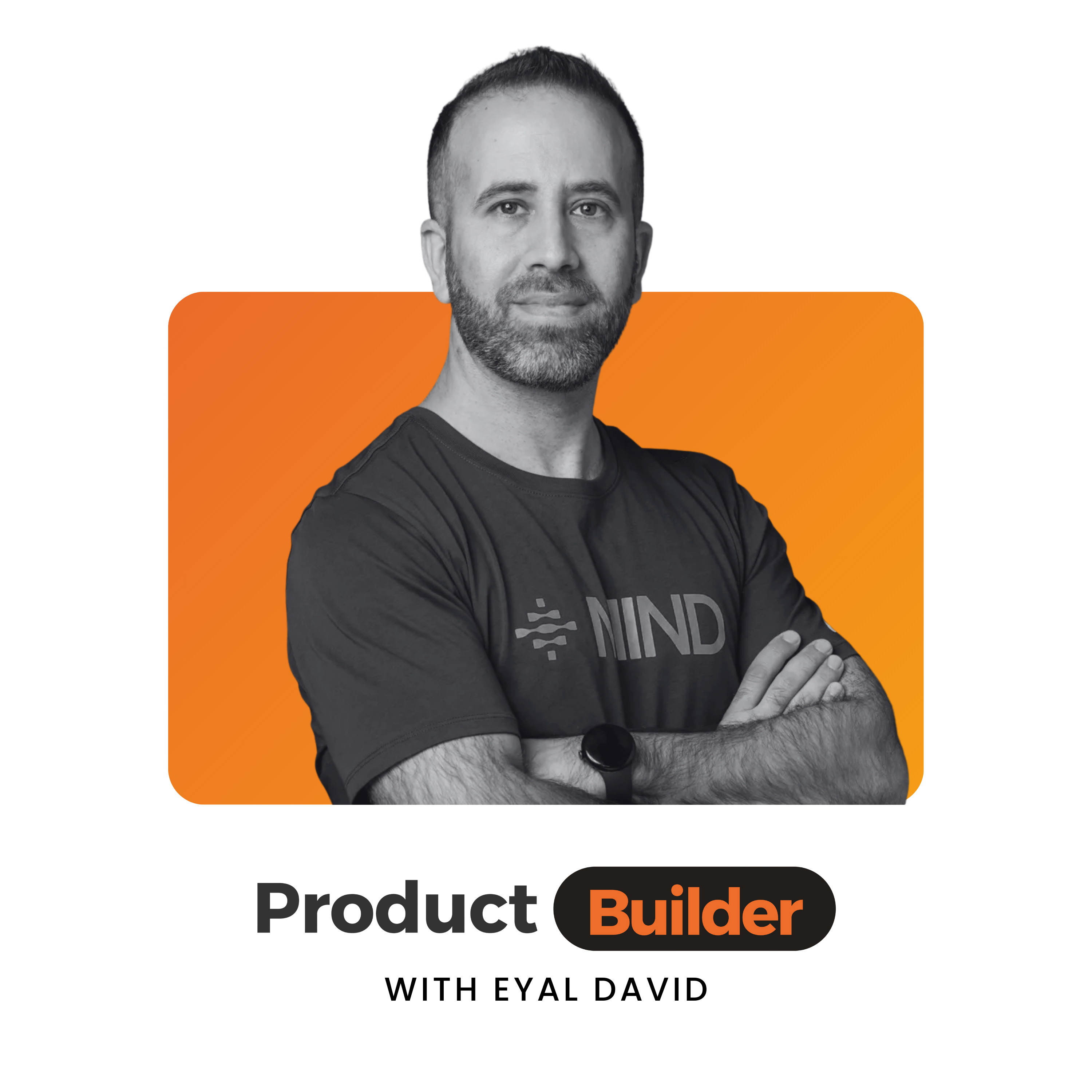
Tom Mayblum | MIND | When Is a Customer Conversation Worth More Than Data?
Host: Eyal David · Guest: Tom Mayblum · About the host
Tom Mayblum is VP Product at cybersecurity company MIND (DLP, data loss prevention) and previously a product manager at Armis. His answer: in B2B, one well-prepared conversation with a few large customers is worth more than a usage chart, because there aren't enough users for the data to be statistically significant. The key is preparation: define the goal of the call in advance, know the customer's history and the role of the person in front of you, and leave with action items.
In this episode
- In B2B there aren't enough users for quantitative data to be significant. Conversations with five large customers matter more than a usage chart, and analytics are mainly for micro-decisions.
- Before every customer call, know what kind of interview it is (discovery, validating a thesis, a feature request or post-usage feedback) and what outcome would make you leave satisfied.
- Preparation covers the customer's history (onboarding, complaints, open commitments) and who you're talking to: buyer or user, CISO or operator. Otherwise you'll be caught unprepared.
- AI raises output but not necessarily outcome. Product's job is focus, aggressive prioritization, and never being engineering's bottleneck.
- Taking the long way pays off: instead of changing a confusing status in five minutes, Tom got on a call with the customer, let him choose the wording, and gained both a clearer product and trust.
Listen to this episode
Episode Description
Tom Mayblum, VP Product at MIND, shares how he built a product organization from scratch at a cyber startup coming out of stealth, and why the challenge for companies today isn't technology but focus and product precision. Most of the episode is about customer conversations: the different types of interviews, how to prepare for each, how to ask questions without looking uninformed, how to handle cultural gaps with American customers, and how to tell whether a call succeeded. Tom tells the story of a one-word change in the product that, thanks to a call with the customer, built trust and fixed a confusing status for every customer, and explains why in B2B he trusts qualitative information more than analytics.
Chapters
- 0:00 · Tom Mayblum and his career path
- 3:23 · Joining MIND and defining success
- 7:39 · Bringing AI into product processes
- 8:49 · Tools and precision in product work
- 13:52 · Defining the goal of an interview
- 18:46 · The right questions for each type of interview
- 25:07 · The long way that pays off: small change, big impact
- 31:32 · Qualitative learning vs. quantitative data
Full transcript with speakers and timestamps
Selected quotes
“The output is higher, but that doesn't at all mean the outcome is better. Our focus as product is on the outcome.”
“I never want the bottleneck to be the PM.”
“One call, or a few calls with five big customers, is much more significant than something in some usage graph.”
Questions & answers
Who is Tom Mayblum?
Tom Mayblum is VP Product at MIND, an Israeli data security (DLP) startup. Before that he spent about five years in product roles at Armis, served about six years in 8200, studied biomedical engineering at the Technion and co-founded an ultrasound startup.
When is a customer conversation worth more than data?
According to Tom, mainly in B2B, where there are no millions of users and statistical significance is hard to reach. A few conversations with large customers give deeper insight than a usage chart, while analytics suit micro-decisions such as how many users got confused creating a policy.
How do you prepare for a customer interview?
Define the type of interview and its goal, learn the customer's history with the company, understand whether you're talking to a buyer or a user, and build a question script, while staying willing to leave it when the customer takes the conversation elsewhere.
How do you ask discovery questions without looking uninformed?
Instead of asking for basic definitions, ask for concrete examples: what it looks like at your company, who works on it, with which tools, and what happened in the last incident. That way you learn a lot without losing the other side's trust.
How do you know a customer interview went well?
Check whether you reached the topic you met for, whether you got an answer or a direction for the decision you need to make, and whether the relationship with the customer got stronger. End every call with a summary, action items and a follow-up touch point.
People & resources mentioned
People
- Tom Mayblum, VP Product at MIND
- Teresa Torres, author on product discovery
Companies & orgs
- MIND
- Armis
- ServiceNow
- Salesforce
Tools
- ChatGPT
- Claude
Related Episodes
Why I Talk Less About Product Now | Coffee with Eyal
00:06:55 · October 7, 2026
"Coffee with Eyal" is a short, informal series in which Eyal David opens the mic over a cup of coffee and shares insights, things he is building and w...

"Fast Is Slow, and Slow Is Fast": Building Right in the AI Era | Amir Frankel (Zero Networks)
00:54:39 · June 7, 2026
Amir Frankel is co-founder and CTO of Zero Networks, a defensive cybersecurity company building micro-segmentation: closing the corporate network by d...

"I was afraid AI would take my job. It sharpened it instead" | Shira Moyal (imagen)
00:43:40 · May 10, 2026
Shira Moyal leads a product team at imagen, a startup that built a personal AI model which learns a professional photographer's editing style and edit...
How to Build AI at the Edge of the Device — Ori Katz, Hailo
00:40:49 · March 5, 2026
Ori Katz, who leads the AI SoC domain at Hailo, tells the story of how an Israeli chip company became a serious player in AI at the edge — smart camer...