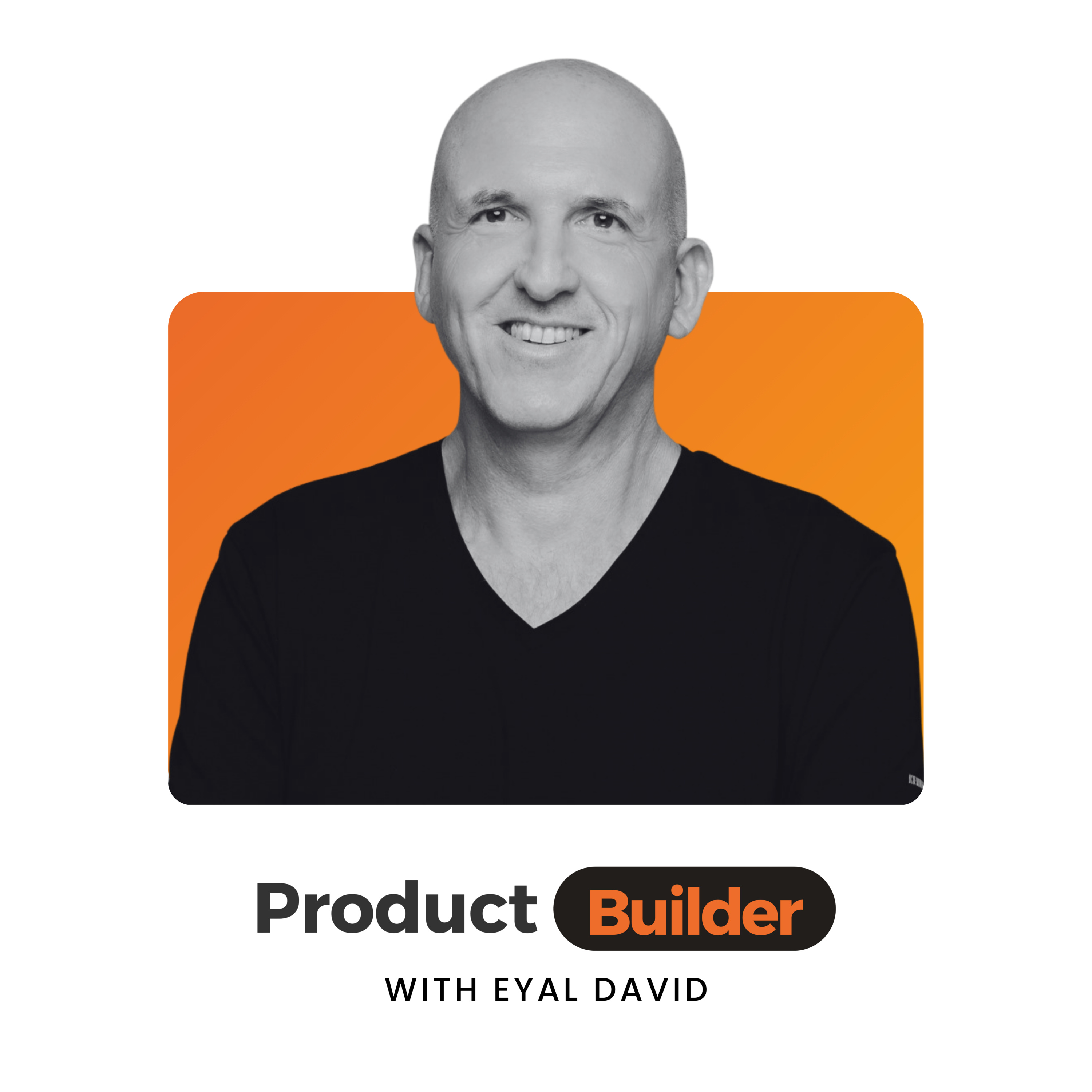
Moving Fast Inside a Giant: Rami Segal on Product, AI, and Agentforce at Salesforce
Host: Eyal David · Guest: Rami Segal · About the host
There's no AI without data — that's the core claim from Rami Segal, a veteran Salesforce product leader who joined the company via its 2019 acquisition of startup Bonobo. According to Segal, Salesforce's Data Cloud strategy (folding in Datorama and Tableau) keeps it from becoming a mere System of Records, as pricing shifts from seat-based to consumption- and outcome-based models.
In this episode
- In a giant organization like Salesforce there's no problem reaching customers — the real challenge is visibility, relevance, and the fight over internal prioritization against competing solutions within the same company.
- There's no AI without data: Salesforce's strategic move (Data Cloud, bringing Datorama and Tableau inside) was meant to bring the customer's data back into the platform, so it wouldn't become merely a back-end System of Records.
- Transforming a decade-old product into a new platform requires a steel thread — a clear backbone you don't move off of — and choosing a team that connects domain people (marketing) with platform people.
- To build trust when launching agents, you keep a human in the loop even when the system can run on its own — the user needs to believe in the tool and press the button themselves.
- Pricing is moving from the traditional seat-based model to consumption, and further toward outcome-based (for example, charging only for a resolved case) — a global trend customers will encounter anyway.
- The future is a conversational interface everywhere, and product people no longer write requirements with their legs crossed — they're half salespeople who get on calls, do discovery, and accompany deployment.
Listen to this episode
Episode Description
Rami Segal is a veteran product leader at Salesforce, who reached the tech giant through the 2019 acquisition of the startup Bonobo. In the episode he opens up wide the question of how you move product and innovation fast inside an organization of 70,000 employees — from integrating a startup into the platform, through rebuilding Datorama inside Data Cloud, to the birth of Agentforce. A conversation about platform dependencies, the shift to consumption and outcome-based pricing, and about the future of product people in the age of AI.

Full transcript with speakers and timestamps
Selected quotes
“There's no AI without data — take the data out of the AI, there's nothing, there's no air there.”
“Everything begins and ends with the conversational interface in the end.”
“As long as people are involved in the purchasing decision-making process, and people need to talk with people, then product people will be there inside the process.”
Questions & answers
What does Salesforce actually do?
Salesforce is a large software company (its stock symbol is CRM) that develops cloud solutions for the worlds of sales, marketing, and customer service — Sales Cloud, Marketing Cloud, and Service Cloud. Its original innovation was building the platform in the cloud back in 2000, as a first mover.
How did Rami get to Salesforce?
Through an acquisition. Rami worked at Bonobo, a startup that analyzed sales calls (speech-to-text, keyword and sentiment detection), and Salesforce acquired it in 2019 to complete its portfolio of AI solutions for the sales world. It was one of the fastest integrations in the company's history.
Why did Salesforce bring Datorama and Tableau inside the platform?
Because there's no AI without data. Salesforce feared becoming merely a System of Records while customers pull their data out to Snowflake or Databricks and build the AI layer there. Data Cloud was meant to flip the equation — to keep the data, the modeling, and the visualization inside Salesforce.
What is Agentforce?
A layer in Salesforce that manages agents. On top of the no-code/low-code platform, each agent represents an action, with actions, logic, and data standing behind it, and can enlist additional agents. It's a conversational interface that helps Salesforce users or their customers perform actions like answering customer service or making sales.
What will happen to the product person's role in the age of AI?
According to Rami, as long as people are involved in software purchasing decisions and need to talk with people, product people will remain in the process. But the role has changed: they no longer write requirements from the sidelines, but have become half salespeople who do discovery, get on calls, and accompany deployment (Forward Deployment Engineer).
Related Episodes
Alex Rif | How Do You Create Real Social Change?
01:02:24 · October 11, 2026
Alex Rif immigrated from Ukraine as a child and spent 20 years trying to be "just Israeli": Magen David Adom, officer training, the Civil Service Cade...

Why I Talk Less About Product Now | Coffee with Eyal
00:06:55 · October 7, 2026
"Coffee with Eyal" is a short, informal series in which Eyal David opens the mic over a cup of coffee and shares insights, things he is building and w...
What Does a Venture Capital Investor Really Look For? | Yael Schiff (Bessemer Venture Partners)
00:58:30 · October 4, 2026
Yael Schiff is an investor at Bessemer Venture Partners, mostly at Seed and Series A, in AI, infrastructure and cyber companies. Before that she spent...
No More Moats: How Harmony Reached 50 Customers Without a Single Salesperson | Ran Ribenzaft (Harmony)
01:00:56 · September 24, 2026
Ran Ribenzaft, Co-Founder and CTO of Harmony (and formerly founder and CTO of Epsagon, sold to Cisco for $500M), is an unusual CTO: 90% of his time go...