
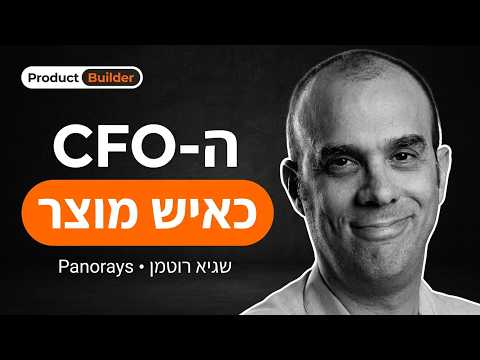
Sagi Rothman | Panorays | Vision, Strategy and Scale
Host: Eyal David · Guest: Sagi Rothman · About the host
Sagi Rothman, CFO of Panorays and former CFO of Verbit, argues that a good CFO works like a product manager: before building, ask whether to build, buy or partner, define success up front, and check the unit economics. His core lesson: operational usage metrics predict renewals and churn long before the bottom line shows anything.
In this episode
- Before rushing to build an MVP, ask whether to build, buy or partner: Verbit bought six companies, and one of them brought 35 years of market knowledge you can't build from scratch.
- A product that works in the lab isn't a business: Verbit built transcription technology that cost two dollars to deliver and sold for one. The fix was finding the right market (legal), not improving the technology.
- Define success before execution: what the goal is, how you'll know you got there, and which KPI will measure it. Many teams skip this step because technology has made building easy.
- Research is done when the numbers converge: when the same conclusions, trends and orders of magnitude keep coming back, you're at 80%. It usually takes about a month.
- Usage metrics predict renewals: a customer who hasn't logged in for a month probably won't renew, even if they've paid. That's why Sagi gets operational dashboards every morning, not just financial ones.
- The CFO is the salesperson for the stock: he translates product capabilities into investor language, the way Snowflake turned its Land and Expand model into the NDR metric.
Listen to this episode
Episode Description
Sagi Rothman, CFO of Panorays, came to the role through the Israeli Navy, Intel Capital, Intel, Amdocs' strategy and M&A group, and five years as CFO of Verbit, where he helped it grow from 70 employees and $4M in revenue to a global company with more than 3,000 customers. In conversation with Eyal David he explains how a CFO can think like a product person: connect vision to strategy and a work plan, weigh Build vs Buy before rushing to an MVP, research until the numbers converge (the 80-20 rule), and stop a product that works in the lab but loses money. He breaks down Snowflake's Land and Expand story and the NDR metric, and explains why daily product-usage dashboards matter to him more than the financial reports.
Chapters
- 1:00 · Sagi's background
- 5:45 · Connecting vision, strategy and a work plan
- 7:00 · Build vs Buy
- 10:00 · The CFO's role in an age of data and technology
- 16:00 · Discovery work: market research, customers and defining success
- 24:00 · When to stop researching, and how to know it's enough
- 29:00 · When a product doesn't make money: back to strategy
- 33:00 · What to learn from CFOs of American tech companies
- 38:00 · Why users matter more than the bottom line
Full transcript with speakers and timestamps
Selected quotes
“It doesn't help much to sell something for a dollar that costs you two dollars.”
“We were solving the right problem for the wrong market.”
“If the salespeople sell the product, you need to be the salesperson for the company's stock.”
Questions & answers
Who is Sagi Rothman?
Sagi Rothman is the CFO of Panorays, a SaaS company for managing the cyber risk of vendors and third parties. Before that he was CFO of Verbit for five years, worked in Amdocs' strategy and M&A group, at Intel and Intel Capital, and served in the Israeli Navy as deputy commander of a missile boat.
How can a CFO think like a product manager?
According to Sagi, the CFO should be a strategic partner to the CEO and to the product and technology organizations: understand technology trends, ask the hard questions about the next year or two, check Build vs Buy and unit economics, and pick up strategic initiatives that nobody is handling.
When should you buy a company instead of building it yourself?
Sagi recommends weighing, before any product strategy, whether to build, buy, partner or combine them. An acquisition takes longer to start and brings different risks, but it is a shortcut: someone has already spent years learning the market.
How do you know you've researched enough before a decision?
Sagi works by the 80-20 rule: when the same numbers, trends and conclusions keep repeating at the same orders of magnitude, more digging adds almost no precision. He then tests his theses with 15 to 20 people he respects in the company.
What can you learn from Snowflake's financial story?
Snowflake turned a Land and Expand product capability into a business model: a small entry deal, and renewals that never drop below the original commitment and roll unused balances forward. That creates a high NDR that investors value, and the CFO tells it as part of one coherent story.
People & resources mentioned
People
- Sagi Rothman, CFO at Panorays
- Tom Livne, founder and CEO of Verbit
Companies & orgs
- Panorays
- Verbit
- Intel Capital
- Intel
- Amdocs
- Snowflake
- Salesforce
- ServiceNow
- Meta
- Gartner
- Forrester
Related Episodes

"I was afraid AI would take my job. It sharpened it instead" | Shira Moyal (imagen)
00:43:40 · May 10, 2026
Shira Moyal leads a product team at imagen, a startup that built a personal AI model which learns a professional photographer's editing style and edit...

Amit Slutzky | Trullion | “I Left Figma and Went Into the Field — It Changed Everything”
00:41:22 · February 24, 2026
Amit Slutzky, Director of Product at Trullion, on one of the most important muscles for product people: understanding what's really going on with the...
Tom Mayblum | MIND | When Is a Customer Conversation Worth More Than Data?
00:33:39 · February 9, 2026
Tom Mayblum, VP Product at MIND, shares how he built a product organization from scratch at a cyber startup coming out of stealth, and why the challen...

Why "I Didn't Hear Anything New" Is the Product Leader's Real Win
00:04:07 · December 21, 2025
Noa Ganot breaks down why product managers fail to move the executive team: it's not a shortage of slide decks, it's the lack of a story that explains...